Barber Shop in Pace, FL: What Actually Belongs on Your Shelf?
A barber shop in Pace, FL can help you answer a surprisingly useful question: which products will make your new cut easy to style tomorrow…


Custom hair color is less about choosing a shade from a swatch and more about creating a color that works with your complexion, hair history, personal style, and real-life maintenance routine.
I love saving dramatic color transformations to my inspiration folders, but the most successful salon results are not always the boldest. They are the ones that still look flattering several weeks later, make sense with the client’s daily routine, and leave the hair looking healthy.
That level of personalization requires more than applying a fashionable formula. It begins with a thoughtful consultation and continues through formulation, placement, processing, finishing, and home care. Here is what separates a truly customized color service from a standard one-size-fits-all experience.
A strong color consultation should feel like a creative conversation, not a rushed selection process. The stylist needs to understand both the desired result and the hair they are working with.
Expect questions about previous permanent color, lightener, glosses, henna, smoothing treatments, and at-home products. Even color that appears to have faded can affect how the hair lifts or accepts a new formula.
A stylist may also ask about:
Bring reference photos, but explain what you like about each one. Perhaps it is the brightness around the face, the soft root, or the contrast between the highlights and base color. That context is often more helpful than asking a stylist to reproduce an image exactly.
Hair color is affected by more than the name printed beside a swatch. Natural depth, existing artificial pigment, porosity, texture, density, and underlying warmth can all influence the final result.
Two people requesting “warm caramel brunette” may need completely different formulas and techniques. One might need subtle lightening followed by a gloss, while another may require lowlights to restore dimension. A stylist must also consider skin tone, eye color, haircut shape, and how the hair moves.
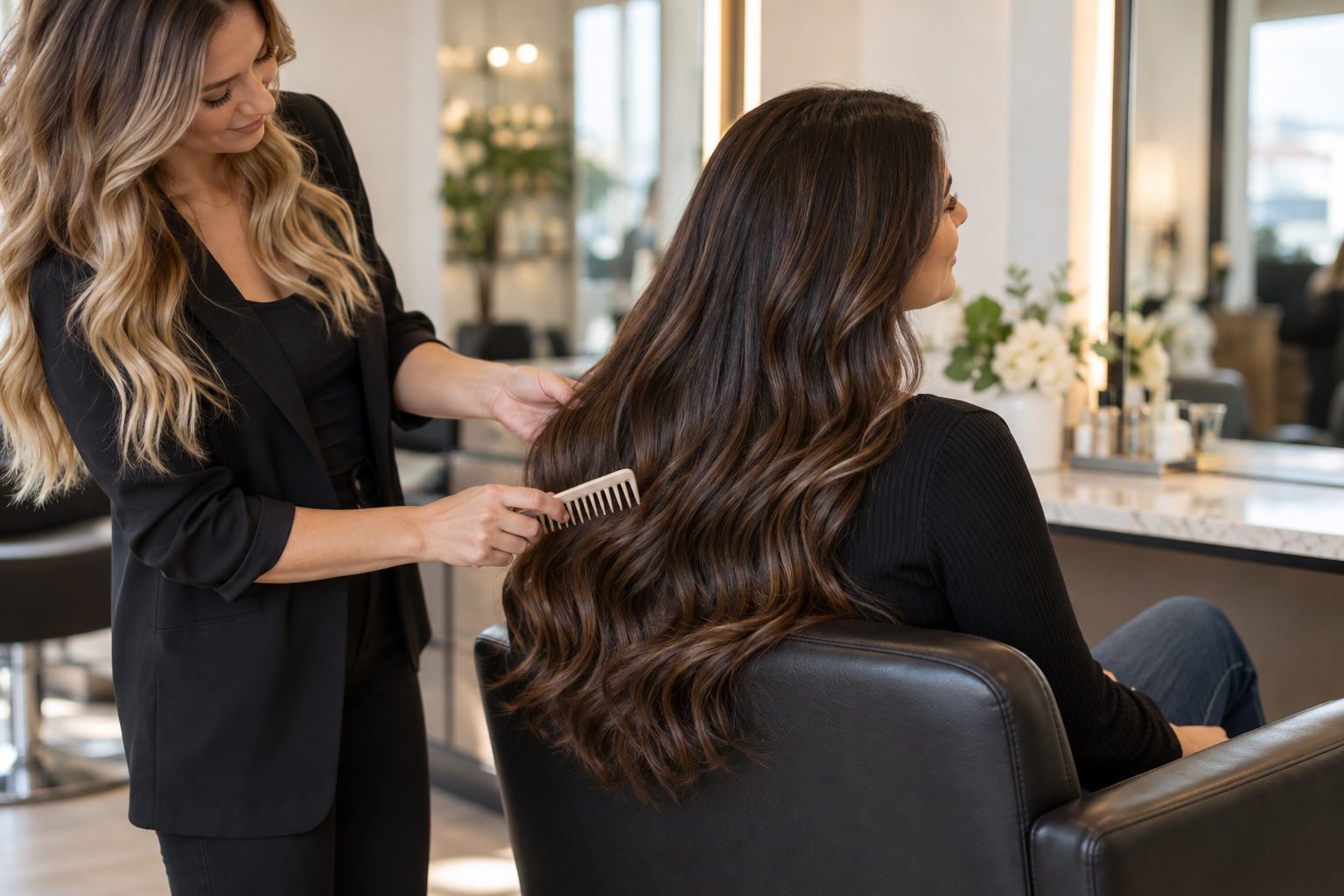
This is where customized placement becomes especially important. Brightness concentrated around the face creates a different effect from evenly distributed highlights. A soft root can make a blonde feel more lived-in, while strategically placed lowlights can prevent the overall color from appearing flat.
There is real structure behind this artistry. A microscopy study available through the National Library of Medicine illustrates how cosmetic processes can affect the hair shaft. It is a useful reminder that the desired shade and the condition of the hair must be considered together.
Balayage, foils, glosses, root shadows, and all-over color are techniques. They are not interchangeable looks, and no single method is automatically better than the others.
Foils provide control and can produce anything from delicate ribbons to high-impact brightness. They are especially helpful when precise lift and consistent separation are needed.
Balayage generally refers to hand-painted lightening. It can create soft transitions and customized placement, although the maintenance level depends on the contrast, tone, and starting color. Balayage is not automatically low-maintenance simply because the word appears on a service menu.
A gloss can adjust tone, deepen color, soften unwanted warmth, or add shine. It can also refresh previously colored lengths without automatically repeating a stronger permanent formula from roots to ends.
Base color may be used to change the natural depth, blend gray, or provide fuller coverage. The right approach depends on the percentage and distribution of gray, the desired level of coverage, and how softly the client wants the color to grow out.
Lightening creates some of the most noticeable transformations, but it also requires realistic expectations. The American Academy of Dermatology notes that dramatically lightening hair generally requires stronger peroxide concentrations and can cause more damage than staying closer to the natural shade.
This does not mean you must abandon a blonde transformation. It means the process may need to happen gradually. A responsible stylist may recommend multiple sessions, a slightly deeper first result, or less lightening on fragile areas.
Before committing to a major change, ask:
A cautious answer is not a lack of skill. In many cases, it is evidence that the stylist is looking beyond the reveal photo and thinking about how the hair will feel afterward.
Anyone with a history of reactions should tell the salon before receiving color. The U.S. Food and Drug Administration recommends following product warnings and conducting a patch test each time hair dye is used. Product instructions and salon protocols may require advance testing.
Do not ignore burning, swelling, intense itching, or a developing rash. The Mayo Clinic’s contact dermatitis guide explains how medical patch testing may be used when the cause of a recurring reaction is unclear.
Readers who want a deeper overview of ongoing research can also review the National Cancer Institute’s hair dye fact sheet. It discusses different categories of dye and summarizes evidence without reducing a complicated subject to an alarming headline.
My personal rating system is simple: consultation quality, technical reasoning, realistic expectations, and a maintenance plan matter more than trendy terminology.
A salon earns extra points when its service menu offers several ways to adjust color instead of pushing every guest toward the same signature look. For example, Amp Studios in Leesburg describes a personalized color approach that includes base color, foil highlights, balayage, color refreshers, glosses, and conditioning glazes. The salon also highlights ongoing stylist education and works with blondes, brunettes, reds, vivid shades, and gray coverage.
That variety matters because customization is really about selecting the right combination of techniques. A subtle brunette refresh may need a gloss and a few surface highlights, while a dimensional blonde may require strategic foiling, toning, and a softer root.
The best color formula can still fade quickly if the aftercare routine works against it. Your stylist’s recommendations should reflect your specific service, but several habits are broadly useful.
Sun exposure deserves more attention than it usually gets. Cleveland Clinic’s guide to protecting hair from sun damage explains that ultraviolet exposure can contribute to dryness, weakness, and fading, particularly in chemically treated hair. The Environmental Protection Agency also provides useful information about UV exposure and the UV Index for planning time outdoors.
No. It can be as subtle as refining a brunette tone, blending early gray, adding a few face-framing highlights, or refreshing faded ends. Personalization refers to the planning and formulation, not the size of the change.
An inspiration photo is a starting point, not a guarantee. Lighting, filters, extensions, natural density, previous color, and styling can change how a result appears. A good stylist translates the mood and key features of the image for your own hair.
Removing or lifting artificial pigment while preserving hair quality can take time. Multiple sessions allow the stylist to assess how the hair responds and avoid pushing fragile areas beyond a reasonable limit.
Price alone does not prove quality. However, customized services often account for consultation time, product usage, hair length, corrective work, stylist experience, and the complexity of placement. Ask what the service includes so you can compare value more accurately.
Truly customized color should feel considered from beginning to end. The best result is not merely fashionable on the day it is finished. It complements the wearer, respects the starting condition of the hair, grows out in an intentional way, and comes with a practical plan for maintaining it.
My advice is to choose a stylist who asks thoughtful questions, explains the process clearly, and is comfortable setting realistic limits. When technical skill and honest communication come together, hair color becomes more than a new shade. It becomes a look designed to belong to you.